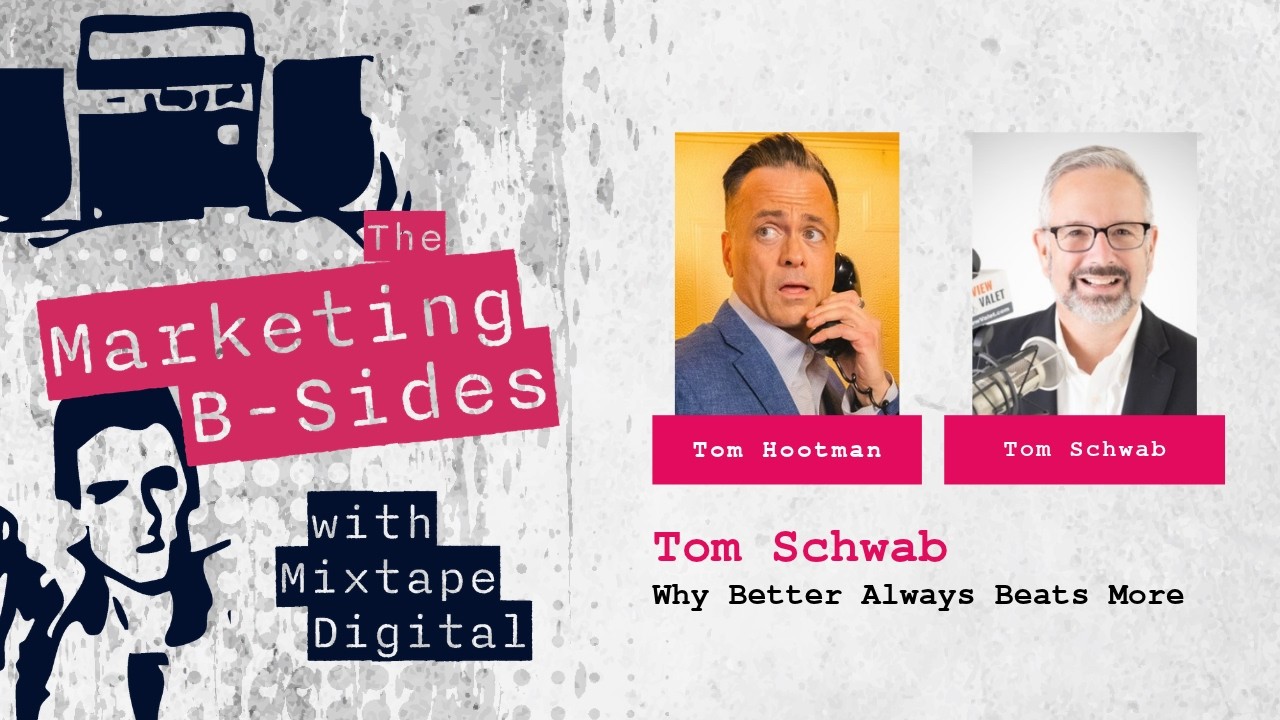
About this Track
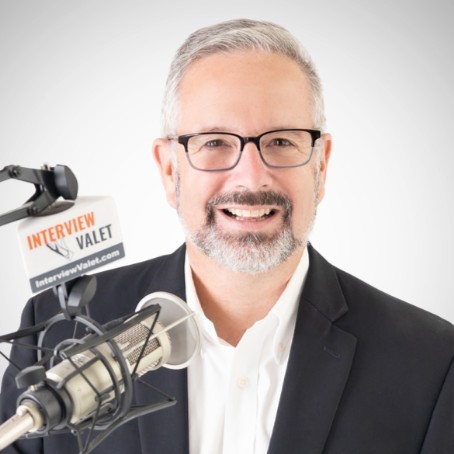
Tom Schwab, founder of Interview Valet and former Navy mechanical engineer, joins Tom Hootman to talk about choosing podcast interviews that reach the right people. After 11 years and more than 1,500 clients, he has plenty to say about chasing exposure for its own sake.
They discuss how long conversations help prospects get to know you before a sales call, why a clear business goal matters when a podcast gets hard to sustain, and how AI became Interview Valet's top referral source. Tom also shares the career turns that took him from nuclear power plants to sales and the leadership lessons that helped him let go of doing everything himself.
Key takeaways
- 01
Choose interviews around a business goal. Tom starts with the audience a client needs to reach and what they want the conversation to accomplish.
- 02
Give prospects a chance to hear you think. Long conversations let people get familiar with your voice and approach before a sales call.
- 03
Keep your reason for podcasting in view. Leads, a book launch, and discoverability call for different choices. A download count alone won't tell you whether it's working.
- 04
Podcast interviews can help people find you through AI. Tom says AI became Interview Valet's top referral source and believes indexed interviews helped drive those recommendations.
- 05
Give your team room to solve the problem. Tom traces his struggle with delegation to ego. Being trusted by leaders in the Navy and at Stryker made him want to deliver.
Because the interview is not the magic. What comes from it is the magic.
Tom Schwab
· at
13:21
Chapters
Select a chapter to jump the player
Transcript
Find in transcript
Tom Hootman (00:06)
Hello, my good friends. Welcome to another episode of the Marketing B Sides. I'm your host, Tom Hootman. I'm also the CEO and founder of Mixtape Digital. In my day job, even though I'm very obviously recording this during the day, don't tell my boss. Um, this is, of course, As always, the podcast where I like to say we're all marketers and yet none of us have any of this shit figured out. Um, it's about the stories, the journeys, the behind the scenes, the stuff that you don't normally hear.
when all you see is um very well crafted, nuanced, sometimes slop LinkedIn posts about how great everything is. The Instagram of business, if you will. I just coined that. Um
It's been kind of hectic here. So Q4, planning for next year. So um, this is our first episode we've done in a few weeks because it's just been so insanely busy in the best possible ways. Um and I am really enjoying the benefits, perks planning, and adjustments to the handbook. So I have an ask for anybody out of the gates. If you watch or listen to this, if either one of you, if either one of you has an idea for
something you've seen or experienced at another workplace that was a really, really fucking cool perk. Um, and Not something where it's just like we we'll be open to tuition reimbursement because we all know how that works. But like Something that's really truly electric, um, that you hadn't seen before. I would love to hear from you and I would love to know what it is. So you know where to reach me. Probably if you listen to this, you're probably in this house or you have my cell phone number.
Or Send me a DM on LinkedIn, or you can email me, tom@mixtapedigital.com. I'd love to hear from you. Um, as you know, I love to talk about journeys and stories, and I'm really honestly proud of like my circuitous journey to where I am today and how I got into digital marketing. And I thought forever I was gonna own a business. I was always wanted to own a business, but I worked in restaurant and retail, so I wanted to own a restaurant really, really badly.
Um, To the point that I even put a business plan together at one point and was talking about funding. That's a whole other story. I decided not to do that one. I think I'm better off because of it. Um, but I somehow then transitioned into selling chicken strips and green beans via US foods into digital marketing, very normal cadence of shift, by the way. Um, Which leads me to today's guest, Tom Schwab. Tom is the founder of Interview Valet. So for over a decade.
they've been booking targeted podcast interviews so people can talk directly to their ideal clients. It's something that resonates with me because one of the hardest parts of this show is honestly finding not just guests, but guests that we feel are within the right specter, the realm of of the theme of the show. and and who would be the right person to talk to for us. It's
It's kind of difficult sometimes because we get a lot of outreach. We do get a lot of outreach for people wanting to be on the show and we we hope no one takes it personally, but we're we really try to we would much rather space out the shows than just to have a guest every other week or every week who isn't a fit or sometimes just wants to sell something. um, but doesn't doesn't fit the spirit of the podcast. So apologies if anyone took it personally, if I say no or the team says no. But it's our show. So sorry. It's We're gonna do what we're gonna do.
Um Tom, Tom's company reached out to me because they do a really wonderful job of finding guests that really match the theme of the show. And they're very cool about hey, if you think this one's a fit, by all means, we'll make an intro. But if not, that's cool too. Um, so I started up a conversation with them, with uh Karen on their side, and found out about Tom, who, like me, has a circuitous path. So very different from me, because Tom was in the Navy
for quite some time, ran nuclear power plants, and then he moved to corporate work at Stryker. And then he was working in straight commissions. Um, very similarly to my family, when he took a straight commission job, they called him a dang fool. although I think Kathy Hootman might have had different words that weren't dang, might have been a little more expletive written, but that's why we love her, Kathy. That's her right there on YouTube. There's hi, Kath. Um, always judging from the back of the room.
Um, We dig into a lot, including like how more is not better. Better is better. Um, how About how some people want to bite off more than they can chew and just drive as many podcasts or be on as many podcasts as possible. And what I've learned, what we've learned as well, is that that's not it doesn't that's not good. Make it make it what's good for you and what's good for your business and for your team and for you personally, versus just trying to hit a number that's made up. Um, we also dug a bit into why podcasting isn't for everybody, why you shouldn't just be on a show.
Um and then also about AI. I know there's a I gotta talk about AI in the first 10 minutes, or you know, when they take over, they won't make me a pet. They'll make me food. Um, So we talk about AI and how it's been their number one referral source, which is wonderful to hear. Um, a lot of it, there's a personal thread in there about delegation, letting go, which really rings true and sings to my heart right now. And fun fact.
You know, I ask every guest for songs for a playlist. And not only did um Tom name two Van Hagar songs, but I knew they were both Van Hagar songs. You should listen with some dialogue about that. But also Van Hagar was my very first concert ever. in nineteen eighty eight at the Joyce Athletic and Comvocation Center at the University of Notre Dame. Go Irish. And special shout out to John Vanigriff, my older brother, for taking me to that concert.
Crazy night. I was like in fifth grade. I won't go into it. Anyway, it's a great show. Tom's a great guest. I love this conversation. As always, let me know what you like, don't like. I'll pretend to care what you don't like for a moment. I will. I'll just cry myself to sleep. Um, Like, subscribe, do all that shit that shows me that you would maybe listen. That'd be great. Or not. I don't care. I don't even look at to be honest with you. So Enjoy the show. Thanks so much, everyone. Talk again soon.
Tom Hootman (06:45)
How's your day so far?
Tom Schwab (06:46)
It's going great, and yours?
Tom Hootman (06:49)
It's going really well. it's Q4 2027 planning. We're trying to figure out what we're gonna do next year, benefits, enrollments. So I just came out of a wonderful HR meeting. But other than that, how's your day?
Tom Schwab (07:02)
It's good to be home. I was on the road for like ten days and while I enjoy it, there's nothing like being home just digging out of all the mail and the emails and stuff like that. So I was looking forward to this today.
Tom Hootman (07:16)
Yeah, I appreciate it. Where's home at for you?
Tom Schwab (07:18)
Kalamazoo, Michigan, so halfway between Chicago and Detroit.
Tom Hootman (07:22)
I'm from South Bend, Indiana originally, so I know Kalamazoo
Tom Schwab (07:25)
We learned South Bend and Mishawaka a lot during COVID. When Michigan was shut down and Indiana was still going, it's like, Hey, you wanna go out for dinner tonight? Yeah, let's drive to Indiana.
Tom Hootman (07:37)
That's actually I mean, when we talk about the conversation today I want to say this you your team wins the award for best planning and advanced info 2026. You had a landing page for Marketing B-Sides you got all this info, amazing info.
It's part of like the journey you were talking about. The thing I'm excited to talk to you about today is I always tell people, I started in retail management. I I worked in Music Land in University Park Mall. And then I
Tom Schwab (08:02)
wow.
Tom Hootman (08:02)
I ended up in restaurants. And then I was selling food to restaurants from US Foods. And then I somehow landed in digital marketing. So I've had like three different careers over the course of my career.
I'm taking great pride in the random ass journey to get to where I'm at today
So tell me about you started multiple companies, you were an engineer in the Navy. How does how the hell does engineer in the navy end up where you are today with a mic, podcast, doing your thing?
Tom Schwab (08:27)
It only makes sense in the rearview mirror, right? So I I grew up in the western suburbs of Chicago, never been more than a hundred miles from my house. By the grace of God and a clerical error, I got into the US Naval Academy and graduated from there. I was a mechanical engineer, ran nuclear power plants, and I thought, okay, my career's gonna be in the Navy. Well,
I was in there just as the Soviet Union was collapsing the last time. And so it's like I want to do something else. So got to the corporate world, realized yeah I don't like being in the corporate world. I want to do more entrepreneurial. I sold, I had my own distributorship, had two businesses now. And to me, like you said, it's every one of your experiences builds for that next thing. When I was in college I wouldn't have said
I'm gonna run a podcast interview marketing agency,
But to me, it's like it's always that evolution of like, what's the next thing? What did I learn here? What can I take it to the next thing? And today we're helping people leverage podcast interviews to talk directly to their ideal clients.
And it's just tapping into other people's audiences, get that transfer of authority. So to me it's not so much a a skill or a diploma. it's really just how you think and Wayne Gretzky said, where's the puck going?
Tom Hootman (09:43)
Yeah, don't skate to where the puck's gonna be. Yeah. It's fascinating because I always wanted to do a podcast. I tell people like when I jumped out of corporate global plate paid media, big thousand person agency life to start this. It was a way of me like admitting to myself, let's do the things that I secretly want to do that I'd never admit to anyone I wanted to do. And
I just start talking to people. And what I've picked up on is like you're right, it's a way to get people in front of their ideal clients. I've heard more feedback from prospective clients and current clients that use it as a way to vibe check and vet potential partners because everyone's telling you the same thing in a pitch or a discovery call. It's like a way for them to see like what do they really like? Because
when you jump into a meet with someone or Zoom for the first time and you're never met a person before, there's an element of like, what's this gonna be like? And I think any advanced info people can get helps educate them on how to approach the conversation. It just makes things much more effective and run more smoothly, honestly.
Tom Schwab (10:43)
I agree with you and I think today it's like proving that it is a person because now it's like we get an email I get an outreach heck I'll get a text message and thinking is this a really a person or not? And so it's almost that proof of life.
Tom Hootman (10:56)
Yeah, that's a great way to put it. Before we get too far into it, tell me a little bit about your business and what you specifically do. Cause I know people are gonna be like, Who's this guy? Two Toms talking. What's Tom Schwab's company do and how did you end up in this podcasting world?
Tom Schwab (11:07)
So the company is Interview Valet and for eleven years we've been helping people leverage targeted podcast interviews to speak directly to their ideal clients. And today AI, right? We've got a team of twenty all employees all in North America. But the thing I look at is what problem do we solve? People that have a great product, a great service, they're the best kept secret.
But they've got to get out there in the world, right? And they have to be that authentic human authority. Today it's not so much about exposure. You can buy ads, you can do everything there. It's about the platform where I can build trust with someone. And that's how I can help them and help myself. And that's really what we've been doing for the last
11 years, helped over fifteen hundred clients, a lot of nonfiction authors, a lot of professional services, a lot of what we call category designers, people that want to be seen as a category of one, the only choice, not just another choice.
Tom Hootman (12:09)
Yeah, I love that because it's matchmaking a bit too. Like it's gotta be hard if you're like, I want to be on more podcasts and you start reaching out to people. The only thing harder than that, in my opinion, is getting the right people on your podcast. Right. And as we've grown this show it's amazing because that's how you and I found each other is is someone reached out from your company and said, Hey, this person would like to be a guest and they were a great fit.
Someone done their due diligence. And I was like, holy shit, thank you. Because it's hard as hell to find guests when you want to release a podcast on a regular cadence, because you want to make certain you can't just say yes to everybody. But as more people reach out, you want to make certain that there's a fit, that you're not forcing it too too much. And that you know, if someone really wants to listen to this show, I want them to be like this this to see some congruency between guest to guest to guest and the stories that they tell. And we've had
multiple guests reach out who are very clearly just trying to pitch to go on the show to pitch. And I think it's even in the advanced info we sent, like, hey, you don't have to sell anything. So please don't sell anything,
I underestimated how hard it is for guests and hosts and shows to match up. It's a job. Right. And you
Tom Schwab (13:18)
And the
Tom Hootman (13:18)
help people kind of cross that chasm.
Tom Schwab (13:21)
And it's a fragmented marketplace, right? So there's no easy way to do it. I'd push back on something you said where you want to get on more interviews. To me, more is not better, better is better, right? So it's not just a numbers game, just the same way you don't want more guests, you want more great guests, interesting guests.
So we always start with what are you trying to accomplish with this? Because the interview is not the magic. What comes from it is the magic.
Tom Hootman (13:51)
People, I think on both sides, we've done this before, right? You get into the expectation of the number or the rhythm, if we're releasing a podcast, ideally every other Tuesday morning, we roll out a new episode. And it's really easy to give yourself that totally made up fake deadline expectation, to just
hitting deadline at any cost. But what we've realized really quickly was find the right guests, have great shows. And if it means it's every Tuesday or two in a week or one a month, the cadence isn't how often it's the quality of the conversation and the storytelling that fits the show more so than anything else.
Tom Schwab (14:30)
Yeah, I can remember a prospect came to me one time and they said, I want to be on 100 podcasts this month. And I'm like, why? And their answer was, because it'll be massive exposure. I mean I'm not the most politically correct. I said, no, streaking is massive exposure. I don't know how this is gonna help your business. Right? We didn't work together, but to me it's just random podcasts, random appearances
will do more to destroy your brand than build it up. So do you want to have a weekly podcast or a podcast every other week that people look forward to listening to, or why don't you drop junk every day? Or you know what? With AI, you could drop junk every hour, right?
Tom Hootman (15:16)
Yeah. So you said you've started a couple businesses. What's been that biggest gamble that you took or which one's the hardest that made you better? That you come out of the other end of and you're like, that was really, really tough, but this has been a great business to start or a great a great job to take or a great position to put myself in. And like what made it so hard?
Tom Schwab (15:34)
There's something that says all suffering is the same, right? No matter where you're suffering at the time, it seems awful, And you realize that it could be worse, So I think going through it, there's been times where you know,
accounts payable is high, accounts receivable is even higher. And you get a letter from the tax man, your silent business partner that says, here's my cut. I think to me those were the most challenging because I didn't feel like I had a lot of control over it. Other things, I felt like it's a problem, but
we'll figure out this problem. And whatever it was, my nephew's got a line that says, Bad times make great stories. In the middle of it, I just think this is going to be a good story someday, or this is going to be a great lesson learned. And probably the ones that are the most memorable is like the loss of a big client or the the loss of a key team member or cash flow.
But those are events where you look at it and say, all right, I can learn something from here and let it destroy me or get better. I think the longer that you go on, the more ups and downs, the more tempered out it gets.
What's the scariest thing?
The scariest thing is what I'm doing right now or the chance that I'm taking right now. How do we scale this? Because all the stuff in the past, I already figured that out.
Tom Hootman (16:49)
Yeah. I love that. And you're right. It's scary and it's challenging. I waited years to to jump out on my own. I always wanted to, but I always realized I came up with excuses or reasons or I kept telling myself it needed to be not just done, but done and great and a super idea. I was trying to mitigate risk.
People say, Do you regret Do you did you we wish you did it sooner? It's like, yes, but you don't know until you jump in, it is hard. I wish I would have started hard years ago because it's fun. Like if you can find the joy in it your toughest days, you'll look back on years from now and be like, that wasn't so bad. It just isn't. You can usually work through it.
I think people are so tied into having an image and looking like they have everything put together. And it's like, sometimes I can think, I don't know how taxes work. Shit. Well, an accountant doesn't do this. I need a CFO Like people are like, you own a business. It must be awesome.
But they only see the good stuff. I wanna be as transparent with people because if someone had done that for me years earlier, it would have given me more confidence to be like, Oh, no one's got this figured out. Let's jump
in.
Tom Schwab (17:51)
I think the older I get the more I realize if someone says they have it all together, they're either lying to themselves or lying to you. And we're all making it up as we go. As you were talking it reminded me when I left the Navy, my dad called me a fool. He's like, you graduated from the Naval Academy. You've got five years in. All you gotta do is spend another fifteen years and you can retire. And I'm like, my marriage and my family will not
survive another deployment. I went into corporate America and then spent about two years in corporate America and went from manufacturing engineer to production supervisor. I was distribution manager for striker instruments and my career was just taking off and I hated it. I wanna go out and sell. And so when I took a straight commission job
My dad called me a dang fool, or words to that effect,
He's like, you're married, you've got a house, you've got kids, you got responsibilities, you can't do this. And I'm like, I'm gonna do this and he lived long enough, a few years later, to say,
that was the right choice for you.
Tom Hootman (18:54)
Yeah.
Tom Schwab (18:55)
And so now, I want to make sure that I'm still taking those big risks, still growing, because there's a lot of problems in the world today, but man, there is no better time to be alive.
Tom Hootman (19:05)
Yeah, there's a saying of like ten years from now you'll wish you were your age now and look back at it with nostalgia just like you're doing now for how you felt ten years ago? When you're
90, you would give anything to be 50 again for a day just to feel as good. But right now, as I'm fifty, all I'm thinking about is the aches and pains and how I wish I was 40 or 30, right? Everyone's always kind of living in reverse that way. It's interesting to me,
one of my best friends, my oldest friend is an engineer. And the jump from engineering to sales. Do you miss the engineer game? Did you enjoy it? I don't you don't see many engineers go into sales, right?
Tom Schwab (19:42)
To me it made total sense because I was selling to orthopedic surgeons at the time. I was in surgery, giving them insights and advice on how to best use artificial knees, hips, shoulders. To me it was a giant engineering problem. While I'm not using the all the engineering skills now, the way it taught me to think
has a applied to everything. I went back and got my MBA later in life and, I can't say that I learned that much from it.
I'm more going back to my engineering things of, what problem are we trying to solve? Are the assumptions wrong? What's the constraint here? There's a lot of just basic engineering terms or engineering thoughts that apply to life.
I don't know if it's such a degree, but what are you gonna do to shape your life and shape your viewpoint on the world so that you can use that as a differentiator going forward?
Tom Hootman (20:31)
Yeah. What experience should you get?
I talked earlier about podcasts and I I volunteered what I thought the hardest part was getting guests and as a guest, probably getting on shows. What do you think is the hardest part of I'll just say the podcast game hosting, being a guest, finding guests, hosting a show? Like it's not easy, but also at the same time it is enjoyable.
I wouldn't do it if I didn't enjoy it. But I I shared with you what I thought was the hardest part. What do you think is the hardest part of it from your POV? I'm really interested in this because you're also helping people get on shows and you're trying to find that alignment. You're seeing kind of the the engineer in you. You're engineering these engagements. Where do you see people struggling the most?
Tom Schwab (21:11)
I think it's starts with the why, right? The data says 80 percent of podcasts die within the first ten episodes. Because your first couple episodes, they're fun, right? It's exciting and then life gets in the way or wow, I didn't blow up as you know, I'm not the next Joe Rogan. And people get discouraged with that. Well what were you trying to do? Was your "why" for doing this
to be the next Joe Rogan? If you don't know why you're doing something, it's hard to continue to do it. And with anything in life, there's that pit of despair. right? When you start working out, guaranteed you're gonna get sore before you get better. That's that why that gets you to the other side. And the same thing with the guest side also, What are you trying to do with this? And I tell every person that comes to us and says, I want to be on podcasts.
That's a hobby, right? If you want another hobby, you don't need our help with this. Why are you doing that? Are you trying to get more leads? Are you trying to promote a nonfiction book? Are you trying to teach AI who you are? All of those things. And if you can keep going back to that of why am I doing this?
Am I making progress towards my why, that gives you the encouragement to keep going. And, it's at a certain time you become that overnight success when your podcast takes off or your business takes off.
Tom Hootman (22:31)
Yeah, I think there's a lot of that mentality. You mentioned the next show, Rogan, but people, I want to do X. If I do X, I should get Y. And the path in between is very nonlinear. And as I like to say, you're gonna scream into the void for a long time. And in my experience, my Y was really just another way to allow people to understand what we're doing and and have people share their stories about how they got there.
I always like to say everyone's a marketer and no one has it figured out, right? Everyone's marketing themselves and they're building their story as they go. It started like that. And for me, we run performance media, like we're all about KPIs and data and metrics. And it's really easy a few months in to be like, so what are we seeing in trends in the data?
What justified it all for me is when it wasn't even the first, but the second, the third, the fourth prospective client who I'm in a discovery call with. And they all kind of make the same joke because I'm always sitting in this room. This is my office. And they're like, I feel like I'm on your podcast right now. That to me means, you did your homework. Like if you watch one minute of it, you know how how weird and crazy I'm gonna be perfect. That means you prepared yourself for today's conversation. And that for me is like that's a vetting tool. It's perfect.
Better than reading a a white paper or a one sheeter.
Tom Schwab (23:43)
Love how you say talking into the void because you're right. There's no immediate feedback when you're a guest or a podcast host. It's like talking into space. Is anybody listening? Sometimes you don't get the perfect data that shows up on a dashboard of like, Google Analytics, but you trust that it's working. And as you were saying that, I'm like, I've been on sales calls before, and somebody stops me and says, It's just weird hearing you at normal speed. And I'm like, what?
And it's like, because I listened to four or five of your podcasts and you were always sped up. This feels different. And I'm like, they know so much more about me. Or Tom, I was on a plane one time and it was the weirdest thing. I was walking off the plane and somebody came up to me and said, Are you Tom Schwab? And my first thought was, you know, are you a process server? and I'm like, Yes.
And he's like, I was sitting behind you and I recognized your voice. And he had heard me from podcast interviews. I didn't look like I do right now. I was on vacation with my family, but he recognized my voice. And it's like there's no other medium where we can build that rapport with people. And the amazing part today is that it was the spring of 2024, so heck, almost going on three years now.
Our number one referral source became AI. And I swear it's because AI indexes the podcast interviews. And so when people are talking about their problems and their questions with AI, we get brought up and recommended. And that is amazing.
Tom Hootman (25:23)
Yeah, that's fantastic. I think that I'm very fortunate that my best friend, he is a podcast junkie. And he's fearless about feedback, constructive, critical, all of it. He is fantastic for me. He'll check in with me months later and be like, Hey, I just listened to this episode and I'll forget that he's listening, right? And he's like, I just listen to this episode, and I want to say, like,
I loved your question when you went down this path and your cadence is just is you're in a rhythm, man. And this is great. Here's something to consider doing next time. And I'm like, holy shit, that is worth its weight in gold. I recognize how fortunate I am to have a a sample size of one even of one individual who's like, that was good. Really good. What would be really cool would be this. And I think a lot of people just don't have that, that feedback. And so part of this is when
someone comes to you and they want to be on a show, I mean, tell me a bit about who do you like who shouldn't be doing this? Like what does it look like when it's not working and someone's not a fit for your business or being on podcasts?
Tom Schwab (26:23)
That's the right question. It's like, why won't this work? Because I'd rather figure that out real early than have an awkward discussion, three months in when we've taken their money. One of our core values is heck yes or no. Right.
So we're always looking and saying, do we know the audience? Have we gotten great results for similar clients? And is this a brand and a message that we would be proud to amplify? And after 11 years, you can see what works and what doesn't. So if somebody, like you said at the beginning, if all they want to do is sell, this is not the medium for it. It will not work. Another one is are they
good conversationalists and we did a study a few years back. Two-thirds of our clients are introverts because that person that is so extroverted that you ask them the question, so tell me about yourself. And 45 minutes later they're wrapping up the question. That doesn't work well. The other thing too is if you want to get ROI on it, right? You've got to have the right kind of market.
I've got a friend here in Kalamazoo. He ran great stereo and home audio, but if you're not within ten miles, twenty miles maybe, you're not a client of his. Being on a podcast would be ridiculous because he's talking to a national audience and only a small, small fraction could be clients. So we look at that. The other thing too is do you have something that needs a conversation?
Right, if I'm selling a commodity, right, do I really need to know who it is? Probably not. But if the founder's story makes a difference, if their point of view makes a difference, if it's something that's interesting, that points out that, hey, this medium will really work for you.
Tom Hootman (28:15)
Do think AI has become a commodity? I get a lot of outreach from executives and people who work in AI who want to talk about AI, it's everywhere, but also like it's exhausting.
Tom Schwab (28:25)
I think there should be a new drinking game, right? Where every time you say AI, somebody's gotta ha take a drink, right? We'd all be drunk before the sunrise came up. I think it's as stupid right now as saying we use electricity or we use computers.
So what? I had a client years ago that told me we're all selling Preparation H, Nobody cares about your product, your service, your story. They care about the pain in the rear end. And so if you want to talk about, you know, what technology is doing to jobs, okay, that might be an interesting conversation. If you want to talk about, what it's doing for
the environment for investing, um for business automation, for for education, all of those little things, those little ideas or topics or problems, those are interesting. But just to say, let's talk about AI. So many people out there that are talking about AI would be hard pressed to tell you what it stands for. And some of them would be hard pressed to spell it.
Tom Hootman (29:25)
Couldn't spell cat if you spotted them the C and the T, is that what it is? Um, yeah,
Tom Schwab (29:29)
something like that.
Tom Hootman (29:30)
Something like that. Well, I think too that a positive that I'm starting to see is that people are starting to realize the value of interpersonal communication. Because authenticity and transparency and human built anything is under attack
some would say. Then you double down on the fact that a lot of us went remote in 2020 and and our worlds haven't really bounced all the way back. We're not in offices. You lose interactions. I always say people are all dicks now when you go out to get gas or you go to a store 'cause like no one wants to talk to anybody because they don't know how. So it's a new natural resource that's been created in just conversation and authenticity and connection
that I think you lose. If you and I were sitting down and and having this conversation live, it would be a different level of connection and authenticity. This is a great way though to be face to face and have a conversation that's two individuals just connecting about what they think, which is kind of lost to some people at this point.
Tom Schwab (30:25)
Lost and also valuable, right? Joe Pelusi from Content Marketing World up in Cleveland, he said something that really struck me. It was that as AI is making content infinite, trust becomes scarce. So in the time that we have been talking here, we both could have sent out
a million cold emails, Very efficient but not very effective. So what can you do that builds that trust and is more effective there? I think that's what podcasting does. That's what personal calls do. heck there's people that are going back to snail mail because they can't get to the regular email boxes. And some of them are doing it creatively. We're heading down to Podfest, which is a big podcasting conference
in January and we always bring our team down there. And people are like, well why would you do that? Because that's where podcasters are. That's where you would meet them. If you want to build a relationship with somebody, be around where they are. And people are like, well can't I just buy an email list? Yes you can. Yeah,
Tom Hootman (31:26)
Yeah, sure, go for it.
Tom Schwab (31:29)
and uh good luck with that.
Tom Hootman (31:31)
Yeah.
You've had a long career and I like asking questions that I like asking myself, like what's a belief you held earlier in your career that as you've evolved and had more experience that you're starting to think of what was I thinking? That was kinda bullshit.
Tom Schwab (31:46)
I would say that I can do everything. There's a quote from the Bible and I always mess it up, I can do all things and I would stop it there. So I would put my head down and it's like if I've got a problem, I'm smart, I'm hardworking, I can figure this out. And if I'd pick my head up, I'd see there was people around me that wanted to help.
There were people around me that had the answer, but they weren't gonna interrupt me because I was working so hard. And it wasn't fun. And even now, like when we're all, remote, it it's easy to just put my head down and work. But now I realize that, if I just take a breath and ask somebody for it, like you said, I don't understand this tax stuff, Ask somebody that does. And after they've been through it, it's like, that's easy, that's straightforward. Or
other team members. We've got 20 people on our team my microphone makes me sound good, my team makes me look good. And so for me it's sometimes just realizing it's more fun playing business as a team sport than trying to do it myself.
Tom Hootman (32:43)
Yeah.
Why do you think you try to do it all yourself? Was it I'm the only one who knows how to do it? I struggle with delegation? Is it the fear that they won't do it the right way? What I've learned is that if you give someone a a task and ask for their help, they usually figure out a way to do it that in a lot of ways is better than I would have done it. Why do you think you held on so tight to like I can do all this myself?
Tom Schwab (33:04)
it's ego. It was all ego of I can take on the burden, I can do it better. And somebody pointed out to me a number of years ago how destructive that was. So I think back when I was in the Navy, The average age of somebody running a nuclear power plant in the Navy is twenty-one years old. And here I was at twenty-five
I was in charge of one or both of the nuclear power plants at one time. When we were in port, the skipper would leave, right? He'd go home to his family, he'd go on other meetings and stuff like that. And he trusted us. He would just say, you're trained, you do this. If there's anything you need, call me. He'd always take the call and stuff like that. But he trusted us. And I'm thinking we always rose to that level.
And I'm thinking, what would it been if the entire time he never left the ship, And just sort of hung over our shoulders and said, if you need anything, if you've got any questions, I'm here. I'm here. It would have been telling us that I don't trust you, I don't believe in you. When I worked for Stryker,
I had the opportunity to work for John Brown, who is the only CEO of a publicly traded company that has grown the company 20% per year for 20 consecutive years. Only company that's ever done
Tom Hootman (34:22)
Mm.
Tom Schwab (34:22)
it. And I can remember we had a big back order issue. And here I am, been with the company a year, get called into the CEO's office
to explain what the problem is. He asks some good questions. And then said, I believe in you. You're the right person to be in charge of this. If you ever need anything, you know where my office is. I wanted to fix that problem more than anything. When we got that back order down, my boss's boss's boss, walked back there and he said,
hey, I was over at corporate today and they asked me to give you this note. And it was a handwritten note from John W. Brown thanking me for doing that. I still have that letter. It means more to me than anything. If he would have been continually checking in and here's how I think you should do it, I wouldn't have worked nearly as hard.
Tom Hootman (35:09)
Twenty years, twenty percent, that's pretty intense. That's really great.
What are you most excited about these days? This could be professional, personal, like as we end to the end, let's t let's end on a good note. What's got you pumped up?
Tom Schwab (35:22)
I would say technology and AI, What we can do today is amazing. The knowledge and the power that we have at our hands today, the world has never known.
You don't need capital, you don't need a degree on this. And so that's what I'm excited about the most. I'm trying to keep my energy and my health going because I don't want to miss this window. People say, when will you retire? And I'm like, I have no desire to retire. It doesn't sound fun to me.
One of my mentors, Dan Miller, he wrote a book called 48 Days, The Work You Love. And he made the observation that your impact on the world should double every 10 years. You know so much more, you've learned stuff, you've got connections, and
he passed away two years ago. And even though that he passed away, I think it's still holding true because all the people that he taught, he mentored, all the great things they're doing, and everybody goes back and saying, yeah, this is all due to Dan Miller.
Tom Hootman (36:23)
Dan Miller. Will prorate his impact for this decade. Thank you very much. One last question for you. My team is Mixtape Digital. I mentioned I worked in a music store. It's funny, I'm hosting a podcast. I'm a music guy. So people like, what podcast do you listen to? Usually I'm listening to like Spotify playlists. If your career had
a two to three song playlist. What songs would you include and why?
Tom Schwab (36:45)
One is from Van Halen. So dreams, right?
Tom Hootman (36:49)
Van Hagar.
Tom Schwab (36:51)
Dreams is Van Hagar too? Okay,
Tom Hootman (36:52)
Believe so, yeah.
Tom Schwab (36:54)
I'm gonna have to double Yes, you were right. It is Van Hagar. So both of are. One is Dreams. All I can think of is the video from that. Remember the T video with the blue angels flying?
Tom Hootman (37:04)
Mm-hmm.
Tom Schwab (37:05)
You know, that's what dreams are made of. So that one pumps me up. And then the other one is right now. There's no tomorrow, right now. Today is everything. Those are the ones. I'll listen to those
before podcast interviews, before events and stuff like Yeah.
Tom Hootman (37:20)
Get you focused and fired up Yeah, yeah, yeah. In the right mindset. I like that.
Fun fact, my very first concert in my life that my brother took me to was Van Hagar at the Joyce Athletic and Convocation Center at the University of Notre Dame. it was in 1988. My first experience with a live music. And I think I was like in fourth grade.
I was like, this is amazing. I need to see more of this. So from there it was all music.
Tom Schwab (37:44)
Marketing B-Sides was launched there. You just didn't know it
Tom Hootman (37:47)
I
Two weeks before Notre Dame took the number one spot in the polls 'cause I remember Sammy Hagar saying something about it. Tom, thank you so much for your time. I love this conversation. I appreciate you. I appreciate you sharing your story with us. Hope I can have you on again sometime soon.
Tom Schwab (38:01)
I hope we get to meet in real life.
There's a great steakhouse down in Bloomington. We'll have to do a second episode from there.
Tom Hootman (38:08)
Little Zagreb.
I used to sell groceries back in the day. See, it all comes full circle. Tom, thanks so much. Take care.
Tom Schwab (38:15)
Thank you, Tom.